Keywords: habit formation; automaticity; lapse; streaks; self-compassion; temporal landmarks; planning software
Abstract
Background. Popular advice holds that a habit forms in 21 days and that a single missed day erases the progress made so far. Field studies that follow habit strength day by day allow both claims to be checked, yet their results rarely reach the people who give or follow such advice.
Aims. We asked how long an everyday habit takes to form, and whether one missed repetition sets that process back.
Method. We conducted a narrative review. Searches of OpenAlex, Semantic Scholar and Europe PMC in October 2026, supplemented by citation tracking, yielded 14 peer-reviewed sources. Each was appraised with the CRAAP test.
Results. In studies that modelled individual learning curves, median time to a plateau of automaticity fell between 59 and 66 days, while individual times spanned 4 to 335 days. Lally and colleagues at University College London found that a single skipped repetition left the trajectory of automaticity essentially unchanged. Seven experiments by Silverman and Barasch showed that a visibly broken streak reduced subsequent engagement, regardless of what people had in fact done, and that self-blame enlarged the loss.
Conclusions. The available evidence places the cost of a lapse in the way it is recorded and interpreted, with little trace in the underlying learning. Software that schedules routines should count repetitions over a period in place of consecutive days, and should return a missed behaviour to its established cue. These conclusions rest on self-reported automaticity in health behaviours; no included study examined adults with ADHD.
1. Introduction
Ask how long a new habit takes and the answer tends to arrive as a single number: 21 days, or sometimes 66. Benjamin Gardner, Phillippa Lally and Jane Wardle (2012), health psychologists at University College London, traced the first figure to Psycho-Cybernetics, a 1960 book by the plastic surgeon Maxwell Maltz. Maltz described patients who grew used to their altered appearance within about three weeks. He was writing about adjustment after surgery, and he measured no habits. The second figure has a sounder origin in a 12-week field study (Lally et al., 2010), yet popular retellings turn its average into a rule and drop the wide spread around it.
Fixed numbers matter because people treat them as deadlines. Someone who expects a routine to run on its own after three weeks, and who still needs effort in week five, has good reason to conclude that the attempt has failed. Gardner, Lally, et al. (2012) warn clinicians about the same problem: patients with unrealistic expectations of how long the process takes may give up while still learning. Many consumer apps add a second source of pressure. They count consecutive days, and a single gap sends the counter back to zero, which tells the user that a month of repetitions has been lost.
Both messages are empirical claims, and both can be tested. Habit research now includes randomised trials with daily measurement and a 2024 meta-analysis. Those results seldom reach the people who build or use planning tools. This review assembles them around two questions:
- RQ1. How long does an everyday behaviour take to become automatic when people repeat it in a stable context?
- RQ2. What does a single missed repetition do to that process, and does the way a tool records the miss alter its consequences?
2. Theoretical background
2.1 Habit as a learned link between context and response
The dominant account comes from Wendy Wood and David Neal at Duke University (2007), later extended by Wood and Dennis Rünger at the University of Southern California (2016). In it, a habit is a memory association between a context and a response. Each performance in that context strengthens the association, until the setting alone prompts the action and deliberate choice becomes optional. Goals start the process by motivating repetition. Once the association exists, though, the cue can trigger the response without consulting any goal. Gardner (2015) reached a compatible definition after a scoping review of 136 empirical studies: habit is the process through which a stimulus produces an impulse to act via a learned stimulus-response association. That impulse can lose out to competing impulses or to a conscious decision.
One property of the account bears directly on lapses. Wood and Neal (2007) argue that these associations build up slowly and resist revision, so that a change in current goals or an occasional counter-habitual act barely shifts them. A theory of this kind predicts that one missed performance should leave the learned association largely intact.
2.2 Measuring habit strength
Field researchers cannot observe a memory association directly, so they ask about its signs. Bas Verplanken and Sheina Orbell (2003) designed the 12-item Self-Report Habit Index (SRHI) around a history of repetition, automaticity and the sense that a behaviour expresses identity. Gardner, Abraham, Lally and de Bruijn (2012) then extracted four automaticity items as the Self-Report Behavioural Automaticity Index (SRBAI), reasoning that automaticity is the active ingredient of habit. Most studies in this review used one of the two instruments. Both depend on a respondent's own impression that a behaviour happens without thought, a limitation discussed in Section 5.
2.3 The asymptotic model
Lally et al. (2010) represented each participant's daily automaticity ratings as a curve that climbs steeply over the first repetitions and then flattens toward a ceiling. The day on which the curve reaches 95% of that ceiling serves as the estimate of formation time. Such an estimate exists only for people whose data the model fits, and that condition shapes how the averages should be read.
3. Method
Design. We carried out a narrative review with a structured search and a formal source appraisal. One author selected and appraised the sources. We registered no protocol and kept no complete screening log, so we report no PRISMA flow diagram.
Search. On 10 October 2026 we queried OpenAlex, Semantic Scholar and Europe PMC with combinations of habit formation, automaticity, missed, lapse, streak, self-compassion and fresh start. We then traced citations backward and forward from Lally et al. (2010), a field study with more than 2,000 citations in OpenAlex.
Eligibility. Empirical papers qualified if they appeared in peer-reviewed journals and either (a) measured habit formation in daily life with repeated automaticity ratings, or (b) tested how people respond to a recorded lapse, a personal failure or a new time period. Theoretical and measurement papers qualified if they defined or operationalised habit and appeared in major journals of the field. We excluded books and popular writing as evidence, along with any paper whose abstract or full text we could not read. That rule removed two relevant studies, one on self-forgiveness for procrastination and one on the abstinence violation effect in smoking cessation. We screened every included record for retraction notices.
Included sources. Fourteen sources met the criteria. Four were field studies of habit formation (Fournier et al., 2017; Kaushal & Rhodes, 2015; Keller et al., 2021; Lally et al., 2010) and one was a systematic review with meta-analysis (Singh et al., 2024). Three tested responses to failure, broken streaks or time landmarks (Breines & Chen, 2012; Dai et al., 2014; Silverman & Barasch, 2023). Six addressed theory, measurement or clinical translation (Gardner, 2015; Gardner, Abraham, et al., 2012; Gardner, Lally, et al., 2012; Verplanken & Orbell, 2003; Wood & Neal, 2007; Wood & Rünger, 2016).
Appraisal and synthesis. Each source was rated on the CRAAP criteria of currency, relevance, authority, accuracy and purpose (Appendix). Outcomes differed too much across studies for pooling, so we synthesised the findings narratively and graded the support for each conclusion in Table 1. Figures come from abstracts, publisher records or full texts read for this review. Popular books by James Clear and Leanne Maskell informed the questions and appear in the discussion as practitioner positions; they carry no evidential weight here.
Conflict of interest. The author founded BBMM Technologies, which develops Flowo, a planning app whose design Section 5 discusses.
4. Results
4.1 The time course of habit formation (RQ1)
Every study that estimated formation time placed the typical value near two months or later, and every study that reported individual variation found it to be large.
The reference study remains the one by Lally, van Jaarsveld, Potts and Wardle (2010). They asked 96 volunteers to choose one eating, drinking or activity behaviour and to perform it once a day in a fixed context, such as after breakfast, for 84 days, rating its automaticity each day. Of the 82 participants with usable data, the asymptotic model described 62 and fitted 39 well. Among those people, the time to reach 95% of the personal ceiling ranged from 18 to 254 days; Gardner, Lally, et al. (2012) later summarised the average as 66 days. Simple actions such as drinking a glass of water became automatic sooner than demanding ones such as 50 sit-ups.
Later studies reproduced the order of magnitude. Jan Keller, Lena Fleig and colleagues at Freie Universität Berlin (Keller et al., 2021) assigned 192 adults to tie a nutrition behaviour to a daily routine or to a clock time. Participants who formed a habit reached peak automaticity after a median of 59 days, and the two cue types performed alike. Marion Fournier and colleagues at Université Côte d'Azur (Fournier et al., 2017) followed 48 students learning a stretch for 90 days. Extrapolated curves put automaticity at roughly 106 days for those who stretched on waking and 154 days for those who stretched before bed, a gap that salivary cortisol levels mediated. In a study of 111 new gym members, Navin Kaushal and Ryan Rhodes of the University of Victoria (2015) identified four sessions a week sustained for six weeks as the minimum needed for an exercise habit.
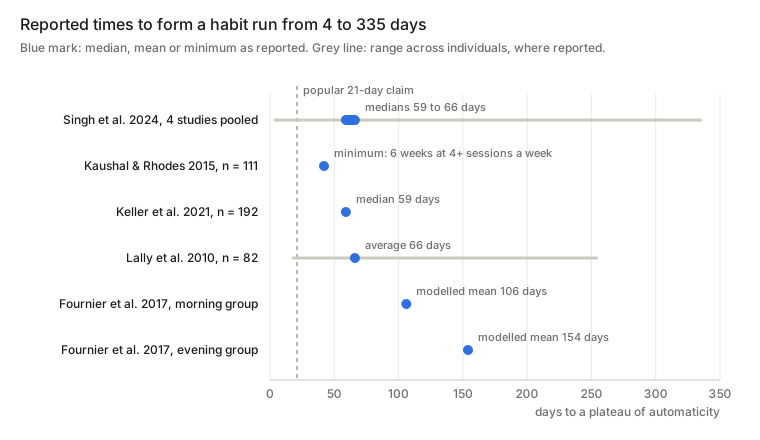
Ben Singh and colleagues at the University of South Australia (Singh et al., 2024) synthesised 20 intervention studies with 2,601 participants aged, on average, 21.5 to 73.5 years. Habit scores rose from baseline to follow-up with a pooled effect of medium size (standardised mean difference 0.69, 95% CI 0.49 to 0.88). Only four studies reported formation time: medians of 59 to 66 days, means of 106 to 154 days and individual values from 4 to 335 days. The authors judged 11 of the 20 studies to carry a high risk of bias, so the pooled figures indicate direction and scale more than precise durations.
Figure 1 sets these estimates side by side. None of them centres on 21 days. A handful of individuals reached automaticity within three weeks, but typical participants needed between two and seven times as long, depending on the behaviour, the person and the time of day.
4.2 A single missed repetition (RQ2, first part)
Among the included sources, one study examined lapses within a modelled learning curve, and it found that a single missed day made no material difference. Lally et al. (2010) recorded each day whether participants performed their chosen behaviour. When a participant skipped one opportunity, the growth of automaticity carried on along the same curve. In their practice guide, Gardner, Lally, et al. (2012) describe the result in clinical terms: progress picked up again shortly after a single omission. Regularity still mattered across the full 84 days, since participants who performed the behaviour more consistently produced curves that the model described more accurately.
The result fits the theory outlined in Section 2. If a habit is an association that strengthens slowly over many repetitions and changes little in response to occasional deviations (Wood & Neal, 2007), then dozens of successful performances outweigh one absence. The evidence base here is thin, however. One field study supports the claim directly, and nobody has yet isolated the effect of two or more consecutive misses.
4.3 A lapse made visible (RQ2, second part)
A separate line of research shows that the record of a lapse can affect behaviour more than the lapse does. Jackie Silverman of the University of Delaware and Alixandra Barasch of INSEAD (Silverman & Barasch, 2023) ran seven studies on behaviours that people log over time, defining a streak as three or more consecutive performances. People shown an intact streak in their log engaged more with the behaviour afterwards than people shown a broken one. The difference held when actual past behaviour was the same and depended on how the log displayed it. The authors attribute the effect to goal formation: once a streak is on display, keeping it alive becomes a goal in its own right. Two moderators followed from that account. Losses after a break grew larger when people attributed the break to themselves, and they shrank when people were allowed to repair the streak.
Taken together, 4.2 and 4.3 separate two costs that everyday advice merges. The missed repetition costs little in habit strength. A display that frames the miss as the end of a run can cost the behaviour itself.
4.4 Conditions that help a routine resume
No included study tested recovery after a lapse as its main outcome. Three bodies of evidence nonetheless bear on it, and they converge on returning to the planned cue at the next opportunity, with no penalty attached to the miss.
Consistent repetition in a stable cue has the most direct support. In the trial by Keller et al. (2021), repeated enactment of the plan predicted automaticity, while the type of cue made no measurable difference. Wood and Rünger (2016) explain why: repetition binds the response to the features of a particular setting, and the setting then does the prompting. By that account, a recovery strategy that shifts the behaviour to a new time, or doubles it later in the day to compensate, abandons the context that earlier repetitions trained. Resuming in the familiar slot keeps that training in use.
The interpretation of the miss shapes the next attempt. Juliana Breines and Serena Chen at the University of California, Berkeley (Breines & Chen, 2012) tested self-compassion in four experiments on personal failure. Compared with participants encouraged to bolster self-esteem and with control groups, those guided toward a kinder view of their own failure spent more time preparing for a difficult test after an initial failure and reported more motivation to change a weakness. Silverman and Barasch (2023) found the mirror image, with self-blame deepening the drop after a broken streak. Practitioners reach similar advice by other routes. Leanne Maskell, writing on ADHD in the workplace, tells readers to expect any personal system to fail at some point and to adjust it without self-reproach; James Clear's heuristic is never to miss twice. Neither rule has been tested as such.
Time boundaries may help people start again. Hengchen Dai, Katherine Milkman and Jason Riis at the Wharton School (Dai et al., 2014) showed in three archival field studies that searches for dieting, gym attendance and goal commitments all rose after temporal landmarks, such as the start of a week, a month or a semester, or a birthday. They propose that landmarks separate a person from past shortcomings by opening a new mental accounting period. Whether an ordinary new day carries a comparable effect has not been studied, so we treat that possibility as a design hypothesis.
5. Discussion
5.1 Principal findings
The review answers RQ1 with moderate confidence and RQ2 with limited confidence. Table 1 grades each conclusion by the design and volume of the evidence behind it.
Table 1. Strength of evidence by conclusion
| Conclusion | Main sources | Designs | Support |
|---|---|---|---|
| A typical everyday habit takes about two months or longer to plateau | Lally et al. 2010; Keller et al. 2021; Singh et al. 2024 | Field study, RCT, meta-analysis | Moderate |
| Formation time varies several-fold across people and behaviours | Lally et al. 2010; Fournier et al. 2017; Singh et al. 2024 | Field study, RCT, meta-analysis | Moderate |
| One missed repetition leaves the learning curve essentially intact | Lally et al. 2010; Wood & Neal 2007 | One field study plus theory | Limited |
| A displayed broken streak lowers later engagement, more so with self-blame | Silverman & Barasch 2023 | Seven experiments | Moderate, consumer settings |
| A self-compassionate response to failure supports renewed effort | Breines & Chen 2012 | Four experiments | Moderate, short-term outcomes |
| Temporal landmarks prompt fresh attempts at goals | Dai et al. 2014 | Archival field data | Moderate for weeks and months; untested for single days |
5.2 A two-layer account of the lapse
We propose an interpretive model, untested as a whole, in which a missed day acts on two layers at once. The first is associative learning, which accumulates over many repetitions and barely registers a single gap. The second is motivational: the person's representation of the effort so far, shaped by trackers, counters and private self-talk. Advice that says a missed day "resets" a habit treats the second layer as if it were the first. The model yields a testable prediction: an identical lapse should reduce later performance more when a display marks it as a break than when the display records it neutrally. It also locates the lever for software, since the motivational layer is the one a display acts on most directly. A counter that resets, or a red mark for a missed day, acts on that layer at the moment a person decides whether to try again.
5.3 Rival explanations
Several alternative readings deserve attention. The Lally estimates came from participants whose data fitted the model, and people who lapsed often may have dropped out of that subset; the harmlessness of a single miss may not extend to frequent missers. Participants also chose their own behaviours, and the study had no comparison group, which limits causal inference about lapses. Self-reported automaticity could also reflect familiarity or expectation more than automatic activation, and Gardner (2015) notes that most habit research relies on correlational designs and self-report. Streaks, finally, carry benefits as well as costs. Silverman and Barasch (2023) found that intact streaks increased engagement, so the net effect of a streak display depends on how often streaks break. For anyone whose schedule varies from day to day, breaks will be common and the balance is likely to tip toward harm, though no study has measured that trade-off directly.
5.4 Implications for planning software
Two design rules follow from the evidence. A tool should record a miss without resetting anything; where it keeps a history, a count of repetitions over a period comes closer than a run of consecutive days to the quantity that predicted automaticity in Keller et al. (2021), namely repeated enactment of the plan. And when a routine is skipped, the tool should offer the next occurrence of its usual context. A missed morning walk belongs in tomorrow morning's slot, since an evening double session would rehearse a different cue.
Flowo, the planning app developed by the author's company, applies the first rule and part of the second. It displays no streak counters, and when a planned task or routine is skipped it rebuilds the remainder of the plan without penalties. The user can edit or reject every proposed placement, including returning a routine to its customary slot. We have not measured the app's effect on habit formation, and the studies reviewed here concern habits in general.
5.5 Limitations
All included habit studies relied on self-reported automaticity, which captures how automatic a behaviour feels to the person performing it. The field studies enrolled between 48 and 192 participants each, and the behaviours were health actions involving eating, drinking, stretching and exercise. The 66-day average describes participants whose ratings followed a clean curve. Fournier et al. (2017) projected their estimates beyond the 90 days they observed, and Singh et al. (2024) rated more than half of their pooled studies at high risk of bias. The streak experiments used consumer settings, leaving clinical and workplace routines untested. We found no study of habit formation in adults with ADHD, so these conclusions make no claim about that population. A single author conducted the search and appraisal, and that author has a commercial interest in the design question.
5.6 Future research
The largest gap concerns consecutive lapses. A design that randomises the number and spacing of omissions within a habit-formation period, in the style of Lally et al. (2010), would show where a gap begins to cost learning. A second priority is a field test of streak displays against period counts in a routine-scheduling app, with automaticity and behaviour as outcomes. Studies of adults with ADHD, whose daily schedules and cue exposure may differ from those of earlier samples, would test whether the formation times reported here generalise.
6. Conclusion
In the studies reviewed, typical estimates of the time an everyday behaviour needs to feel automatic ran from about two to five months, and individual times varied more than any single figure can convey. A single missed repetition left that learning essentially intact. The measurable damage of a lapse appeared later, in how a record displayed it and how the person judged it. People starting a routine can therefore plan in months and, after a gap, pick up again at the usual cue. Tools that support them should treat a miss the same way, as an event in the schedule with no verdict attached.
References
- Breines, J. G., & Chen, S. (2012). Self-compassion increases self-improvement motivation. Personality and Social Psychology Bulletin, 38(9), 1133-1143. https://doi.org/10.1177/0146167212445599
- Dai, H., Milkman, K. L., & Riis, J. (2014). The fresh start effect: Temporal landmarks motivate aspirational behavior. Management Science, 60(10), 2563-2582. https://doi.org/10.1287/mnsc.2014.1901
- Fournier, M., d'Arripe-Longueville, F., Rovere, C., Easthope, C. S., Schwabe, L., El Methni, J., & Radel, R. (2017). Effects of circadian cortisol on the development of a health habit. Health Psychology, 36(11), 1059-1064. https://doi.org/10.1037/hea0000510
- Gardner, B. (2015). A review and analysis of the use of "habit" in understanding, predicting and influencing health-related behaviour. Health Psychology Review, 9(3), 277-295. https://doi.org/10.1080/17437199.2013.876238
- Gardner, B., Abraham, C., Lally, P., & de Bruijn, G.-J. (2012). Towards parsimony in habit measurement: Testing the convergent and predictive validity of an automaticity subscale of the Self-Report Habit Index. International Journal of Behavioral Nutrition and Physical Activity, 9, 102. https://doi.org/10.1186/1479-5868-9-102
- Gardner, B., Lally, P., & Wardle, J. (2012). Making health habitual: The psychology of "habit-formation" and general practice. British Journal of General Practice, 62(605), 664-666. https://doi.org/10.3399/bjgp12X659466
- Kaushal, N., & Rhodes, R. E. (2015). Exercise habit formation in new gym members: A longitudinal study. Journal of Behavioral Medicine, 38(4), 652-663. https://doi.org/10.1007/s10865-015-9640-7
- Keller, J., Kwasnicka, D., Klaiber, P., Sichert, L., Lally, P., & Fleig, L. (2021). Habit formation following routine-based versus time-based cue planning: A randomized controlled trial. British Journal of Health Psychology, 26(3), 807-824. https://doi.org/10.1111/bjhp.12504
- Lally, P., van Jaarsveld, C. H. M., Potts, H. W. W., & Wardle, J. (2010). How are habits formed: Modelling habit formation in the real world. European Journal of Social Psychology, 40(6), 998-1009. https://doi.org/10.1002/ejsp.674
- Silverman, J., & Barasch, A. (2023). On or off track: How (broken) streaks affect consumer decisions. Journal of Consumer Research, 49(6), 1095-1117. https://doi.org/10.1093/jcr/ucac029
- Singh, B., Murphy, A., Maher, C., & Smith, A. E. (2024). Time to form a habit: A systematic review and meta-analysis of health behaviour habit formation and its determinants. Healthcare, 12(23), 2488. https://doi.org/10.3390/healthcare12232488
- Verplanken, B., & Orbell, S. (2003). Reflections on past behavior: A self-report index of habit strength. Journal of Applied Social Psychology, 33(6), 1313-1330. https://doi.org/10.1111/j.1559-1816.2003.tb01951.x
- Wood, W., & Neal, D. T. (2007). A new look at habits and the habit-goal interface. Psychological Review, 114(4), 843-863. https://doi.org/10.1037/0033-295X.114.4.843
- Wood, W., & Rünger, D. (2016). Psychology of habit. Annual Review of Psychology, 67, 289-314. https://doi.org/10.1146/annurev-psych-122414-033417
Appendix: CRAAP appraisal
All 14 sources passed. Ratings run from 1 (weak) to 3 (strong). No source carried a retraction notice on 10 October 2026.
| Source | Design, sample | Currency | Relevance | Authority | Accuracy | Purpose | Main caveat |
|---|---|---|---|---|---|---|---|
| Lally et al. 2010 | Field study, 84 days, n = 82 analysed | 2 | 3 | 3 | 2 | 3 | Good model fit for 39 participants |
| Keller et al. 2021 | RCT, 84 days, n = 192 | 3 | 3 | 3 | 3 | 3 | One nutrition behaviour per person |
| Fournier et al. 2017 | RCT, 90 days, n = 48 | 2 | 2 | 3 | 2 | 3 | Times extrapolated past observation |
| Kaushal & Rhodes 2015 | Longitudinal survey, 12 weeks, n = 111 | 2 | 2 | 3 | 2 | 3 | Self-selected gym members |
| Singh et al. 2024 | Systematic review and meta-analysis, 20 studies, n = 2,601 | 3 | 3 | 2 | 2 | 3 | 11 of 20 studies at high risk of bias |
| Silverman & Barasch 2023 | Seven experiments | 3 | 3 | 3 | 3 | 2 | Consumer framing, aimed at firms |
| Breines & Chen 2012 | Four experiments | 2 | 2 | 3 | 2 | 3 | Student samples, short-term outcomes |
| Dai et al. 2014 | Three archival field studies | 2 | 2 | 3 | 2 | 3 | Correlational; daily boundaries untested |
| Wood & Neal 2007 | Theoretical review | 1 | 3 | 3 | 3 | 3 | No new data |
| Wood & Rünger 2016 | Annual review | 2 | 3 | 3 | 3 | 3 | Broad scope |
| Gardner 2015 | Scoping and narrative review, 136 studies | 2 | 2 | 3 | 3 | 3 | Definitional focus |
| Gardner, Abraham, et al. 2012 | Measurement validation, secondary and primary data | 2 | 2 | 3 | 3 | 3 | Energy-balance behaviours only |
| Gardner, Lally, et al. 2012 | Clinical practice article | 2 | 3 | 3 | 2 | 3 | Restates Lally; origin of the 21-day claim |
| Verplanken & Orbell 2003 | Scale development, four studies | 1 | 2 | 3 | 3 | 3 | Self-report by design |
Related: re-planning a day that slipped, breaking a task into steps, and how Flowo decides where tasks go.
Flowo is free to download on the App Store for iPhone and on Google Play for Android, with optional in-app purchases.