Split the job. In the evening, write a specific list of what is unfinished and what comes next, because small experiments suggest this helps people let go of work and fall asleep; in the morning, give those items clock times, once you can see the day's meetings and likely interruptions. Be aware that no study has compared evening planning with morning planning directly, so this advice is pieced together from research on unfinished goals and on daily planning at work.
What the research says
Unfinished tasks follow you into the evening. In a 12-week diary study of 59 employees, weeks that ended with more unfinished tasks were followed by more affective rumination and worse sleep over the weekend (Syrek et al., 2017). An earlier diary study of 89 employees found the same link between unfinished tasks, rumination and weekend sleep, even after accounting for time pressure (Syrek & Antoni, 2014).
A concrete plan can quiet an unfinished goal. In a series of lab experiments, unfinished goals produced intrusive thoughts and worse performance on unrelated tasks, and letting people write a specific plan for the goal removed those effects (Masicampo & Baumeister, 2011). The people whose thoughts quietened were the ones who later carried their plans out, so a vague plan is unlikely to do the same work.
A bedtime to-do list helped people fall asleep faster in one lab study. Scullin et al. (2018) randomly assigned 57 healthy adults aged 18 to 30 to write for five minutes before bed, either a list of tasks still to do or a list of tasks already done. The to-do group fell asleep faster, and the more specific their list, the faster they fell asleep. The sample was small, young and healthy, and it was a single night in a sleep laboratory.
End-of-day plans helped people who struggle to switch off. In a study of 103 employees and 1,127 work goals, people found it harder to detach in the evening from goals they had left incomplete. In an experiment within the same study, making plans for those goals increased detachment among employees whose traits make detaching hard, which suggests the benefit is uneven (Smit, 2016).
Morning task lists help less on interrupted days. Parke et al. (2018) surveyed 187 full-time employees each morning and afternoon for two work weeks; interviews had shown that most planned at or just before the start of work. On days with many interruptions, the benefit of a prioritised task list shrank. Planning for possible interruptions, with fallback actions, was linked to better engagement and performance whatever the level of interruption.
Two broader findings set the scale. Plans that name when and where you will act had a medium-to-large effect on reaching goals across 94 tests (d = .65; Gollwitzer & Sheeran, 2006). Time management in general correlated about .25 with job performance across 158 studies and 53,957 participants, with a somewhat stronger link to wellbeing (Aeon et al., 2021). Those numbers are mostly correlational and say nothing about the time of day you plan.
How to do it
- Stop work ten minutes early. If you usually close the laptop at 5:30pm, start the evening list at 5:20. A five-minute version at bedtime is the next best option, since that is what the sleep study tested.
- Write every unfinished item with its next physical step. "Budget draft" becomes "open the Q4 sheet and fill in the travel line". The specificity of the list mattered in both the plan-making and the sleep experiments.
- Add a rough when for each item. "Thursday, before the 11:00 call" or "after school pickup" is enough. Leave exact times for the morning.
- Mark the one or two items that have to happen tomorrow. Everything else is allowed to wait a day.
- In the morning, look at the fixed events first, then set times. Spend five minutes: check the calendar for anything fixed, then give the marked items real slots, such as a 40-minute report at 2pm.
- Write one if-then line for the likeliest interruption. "If the 9:30 runs over, the budget draft moves to 2:00 and the vendor emails drop to Friday." That is the kind of contingent planning that held up on interrupted days.
A decision rule for who should lean which way: if unfinished work keeps you up or follows you home, put more weight on the evening list. If the shape of your day is unknown until the morning (rotating shifts or on-call work), keep the evening list short and do more in the morning. If you are interrupted most days, never skip step 6.
A worked example
Here is a Wednesday and Thursday for someone who works 9 to 5:30 and does school pickup at 3:15 on Thursdays.
- Wednesday 5:20pm. Four things are unfinished. The list reads: "Budget draft: fill in travel line, then send to Sam. Vendor emails: reply to the two from Monday. Slide deck: add the October numbers. Leo's rain boots: order online." Rough whens: budget before the 11:00 call, emails after lunch, slides Friday, boots tonight.
- Wednesday 5:28pm. Budget draft is marked as the item for Thursday. Laptop closed.
- Wednesday 9:10pm. Boots ordered. A thought about the slide deck surfaces at 10:40pm; it is already on the list with a day attached, so it can wait.
- Thursday 8:45am. Calendar check: 9:30 stand-up, 11:00 client call, 3:15 pickup. Times set: budget draft 9:45 to 10:45 (estimated at an hour), vendor emails 1:30 to 2:10.
- Thursday 8:50am. The if-then line: "If the stand-up runs past 10:00, budget goes to 1:30 and emails move to Friday morning."
- Thursday 10:05am. The stand-up does run over. The fallback is already written, so the switch takes seconds and the client call still starts at 11:00.
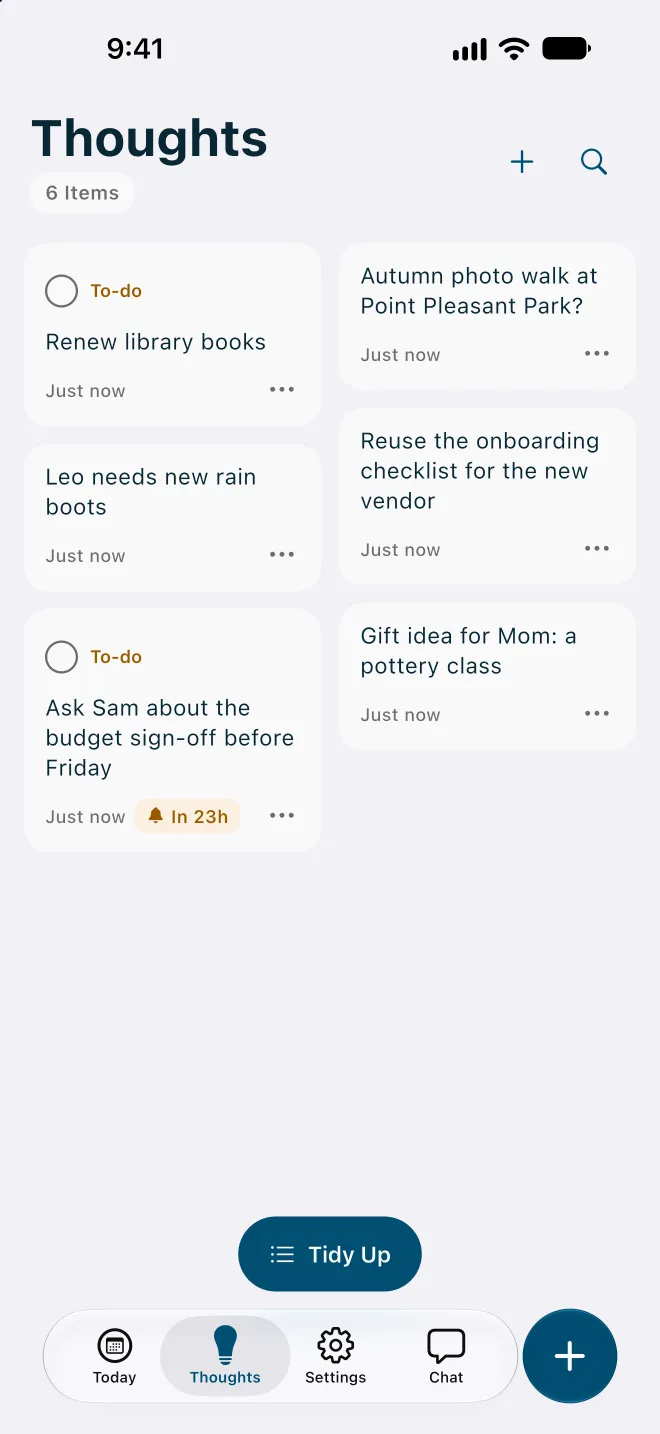
In Flowo, the evening list can go straight into Brain Dump (the Thoughts tab) as unsorted notes, without choosing a project or time; the next morning you can turn a selected note into a task with a duration and deadline, and the scheduler proposes slots around your fixed events, habits and day boundaries. When the stand-up runs over, asking it to re-plan proposes new placements for the unfinished work in the time left, and you can edit any of them.
When this does not work
If writing the list starts a worry spiral. The sleep study asked for five minutes of concrete items. If listing tomorrow's work at night makes you more anxious, move the list to the end of the workday or keep it to three lines, and see whether that helps.
If your evenings are your heaviest work time. Students and shift workers may finish work at midnight. The same split applies at whatever point your working day ends, though the research above studied office workers and young adults on regular schedules.
If you already switch off easily. In Smit's (2016) experiment, the benefit of end-of-day plans showed up among people who find it hard to detach. If work rarely follows you home, a short morning session may be all you need.
Limits of the evidence. No study here randomised people to plan in the evening or in the morning and compared the results. Most of the work studies are diary studies, which show links within people over time but cannot prove cause, and none of them studied people with ADHD or other conditions specifically.
Questions
Does writing a to-do list before bed help you sleep?
In one controlled lab study of 57 young adults, five minutes spent writing a specific to-do list led to falling asleep faster than writing about completed tasks (Scullin et al., 2018). It is one small study, so try it for a week and see what it does for you.
Is it better to plan the week on Sunday instead?
A weekly look helps you see deadlines and fixed events, but the interruptions that break a plan arrive day by day. Many people combine a short weekly review with the evening list and the morning time-setting described here.
How long should daily planning take?
The studies used short sessions: five minutes of writing in the sleep study and brief morning surveys in the workplace study. About ten minutes in the evening and five in the morning fits that evidence, and nothing here shows that longer planning gives better results.
References
- Aeon, B., Faber, A., & Panaccio, A. (2021). Does time management work? A meta-analysis. PLOS ONE, 16(1), e0245066. https://doi.org/10.1371/journal.pone.0245066
- Gollwitzer, P. M., & Sheeran, P. (2006). Implementation intentions and goal achievement: A meta-analysis of effects and processes. Advances in Experimental Social Psychology, 38, 69-119. https://doi.org/10.1016/S0065-2601(06)38002-1
- Masicampo, E. J., & Baumeister, R. F. (2011). Consider it done! Plan making can eliminate the cognitive effects of unfulfilled goals. Journal of Personality and Social Psychology, 101(4), 667-683. https://doi.org/10.1037/a0024192
- Parke, M. R., Weinhardt, J. M., Brodsky, A., Tangirala, S., & DeVoe, S. E. (2018). When daily planning improves employee performance: The importance of planning type, engagement, and interruptions. Journal of Applied Psychology, 103(3), 300-312. https://doi.org/10.1037/apl0000278
- Scullin, M. K., Krueger, M. L., Ballard, H. K., Pruett, N., & Bliwise, D. L. (2018). The effects of bedtime writing on difficulty falling asleep: A polysomnographic study comparing to-do lists and completed activity lists. Journal of Experimental Psychology: General, 147(1), 139-146. https://doi.org/10.1037/xge0000374
- Smit, B. W. (2016). Successfully leaving work at work: The self-regulatory underpinnings of psychological detachment. Journal of Occupational and Organizational Psychology, 89(3), 493-514. https://doi.org/10.1111/joop.12137
- Syrek, C. J., & Antoni, C. H. (2014). Unfinished tasks foster rumination and impair sleeping: Particularly if leaders have high performance expectations. Journal of Occupational Health Psychology, 19(4), 490-499. https://doi.org/10.1037/a0037127
- Syrek, C. J., Weigelt, O., Peifer, C., & Antoni, C. H. (2017). Zeigarnik's sleepless nights: How unfinished tasks at the end of the week impair employee sleep on the weekend through rumination. Journal of Occupational Health Psychology, 22(2), 225-238. https://doi.org/10.1037/ocp0000031
Conflict of interest: the author is a co-founder of Flowo, a planning app. None of the studies cited was funded by or connected to the company.
Related: re-planning a day that has slipped, planning around classes, shifts and appointments, and how the scheduler works.
Flowo is free to download on the App Store for iPhone and on Google Play for Android, with optional in-app purchases.