Write down the start and end times of the tasks you repeat for a week, then estimate each one from that record. People tend to remember past tasks as shorter than they were, and in lab experiments predictions were close to accurate when someone had recently done the same task. The evidence is moderate: most of it comes from students doing short tasks, and a review of the wider literature found underestimation less consistent in psychology experiments than in workplace projects.
What the research says
Underestimation is common, with exceptions. Students in one study expected to finish their thesis in 33.9 days on average; it took 55.5, and 29.7% were done by the date they gave as their best guess (Buehler et al., 1994). A review of time prediction research found underestimation reported more often than overestimation in engineering and management studies, a pattern that did not hold in studies from the psychology literature (Halkjelsvik & Jørgensen, 2012). So expect to run over on real projects, and do not assume every guess is too low.
Memory of past durations runs short. A review in Psychological Bulletin argued that people do base predictions on how long similar tasks took, and that those memories are themselves too short (Roy et al., 2005). Familiarity can make this worse. In one study the review describes, novices overestimated a Lego task by 3% and experts underestimated it by 32% (Hinds, 1999, as cited in Roy et al., 2005). The review's practical advice is to record start and end times for important tasks and to keep doing so, so you can see the average and the spread.
Very short tasks go the other way. For tasks lasting 1 to 15 minutes, those under about 2 minutes tended to be overestimated, and longer ones underestimated, both in memory and in prediction (Roy & Christenfeld, 2008). The review cautions that part of this short-over, long-under pattern may be a statistical artifact of random error (Halkjelsvik & Jørgensen, 2012).
A record of the same task helps more than a bare number. In three experiments with 40 to 80 students, people who repeated the same task a week later predicted its duration closely, about 8% over in the first experiment, while those who had done a different task first were about 46% under. Telling people how long the first task took had no significant effect on its own (Thomas & König, 2018). Estimates also drifted toward whatever task came just before: after a short task, people underestimated a longer one (Thomas et al., 2007).
Splitting and linking to the past raise estimates, which only partly fixes them. In three experiments, the times people gave for the parts of a task added up to more than the time they gave for the whole (Forsyth & Burt, 2008). When 123 students described past assignments and tied their prediction to them, their average forecast matched the average finish time (7.0 days each), and 60% finished by the predicted date against 29.3% in the control group. Their individual errors were no smaller, though; the correction moved the average without making each guess more precise (Buehler et al., 1994).
How to do it
- Pick three tasks that come back every week. For example a weekly report, a batch of email replies and a grocery run. Leave one-off projects for later.
- Before each one, write your estimate. As you work, write the clock times. A line in a notes app is enough: "Report, guess 60, 9:02 to 10:37." Count interruptions inside the task, since the finish time is what your calendar has to hold.
- After a week, divide what it took by what you guessed. A report guessed at 60 minutes that took 95 has a ratio of about 1.6. With three or more entries, use the middle one. This ratio is a working rule built from the findings above, and no study has tested it.
- Estimate repeat tasks from their own record. If the last three reports took 85, 95 and 110 minutes, book 95 and know that 110 is possible. Matching the task matters more than having some number (Thomas & König, 2018).
- For a task you have never timed, list the parts and add them up. Then multiply by your middle ratio from step 3. The sum of the parts tends to come out longer than a single guess (Forsyth & Burt, 2008), and the ratio adds what your own record says about you.
- Leave tasks of a minute or two alone. They tend to be overestimated already (Roy & Christenfeld, 2008). Group them into one 15-minute block and stop padding each one.
- Check the log right after a quick task. If you just cleared a ten-minute form, your guess for a two-hour job may be pulled short (Thomas et al., 2007).
The decision rule, in one line: timed three or more times, use the middle actual; timed once, use that time; never timed, add the parts and apply your ratio.
A worked example
It is Monday. Last week's log has three vendor-email batches at 35, 40 and 45 minutes (all guessed at 30) and one weekly report at 95 minutes (guessed at 60). The middle ratio across those entries is about 1.3. There is a team meeting at 11:00 that cannot move.
8:50. Open the log. Three minutes.
9:00 to 10:35. The weekly report, booked at 95 minutes because that is what it took last time.
11:00 to 11:45. The meeting.
12:50. A task you have never timed: draft the fall campaign budget. List the parts: pull last year's figures (15 minutes), update the cost lines (30), write a short summary (20), send it for review (5). That adds up to 70 minutes, and at a ratio of 1.3 you book 90.
1:30 to 3:00. The budget draft.
3:00 to 3:40. Vendor emails, booked at 40, the middle of three timed batches.
3:55. The budget took 105 minutes, so the emails ran from 3:15 to 3:55. Write both actuals in the log. Next quarter's budget starts from 105.
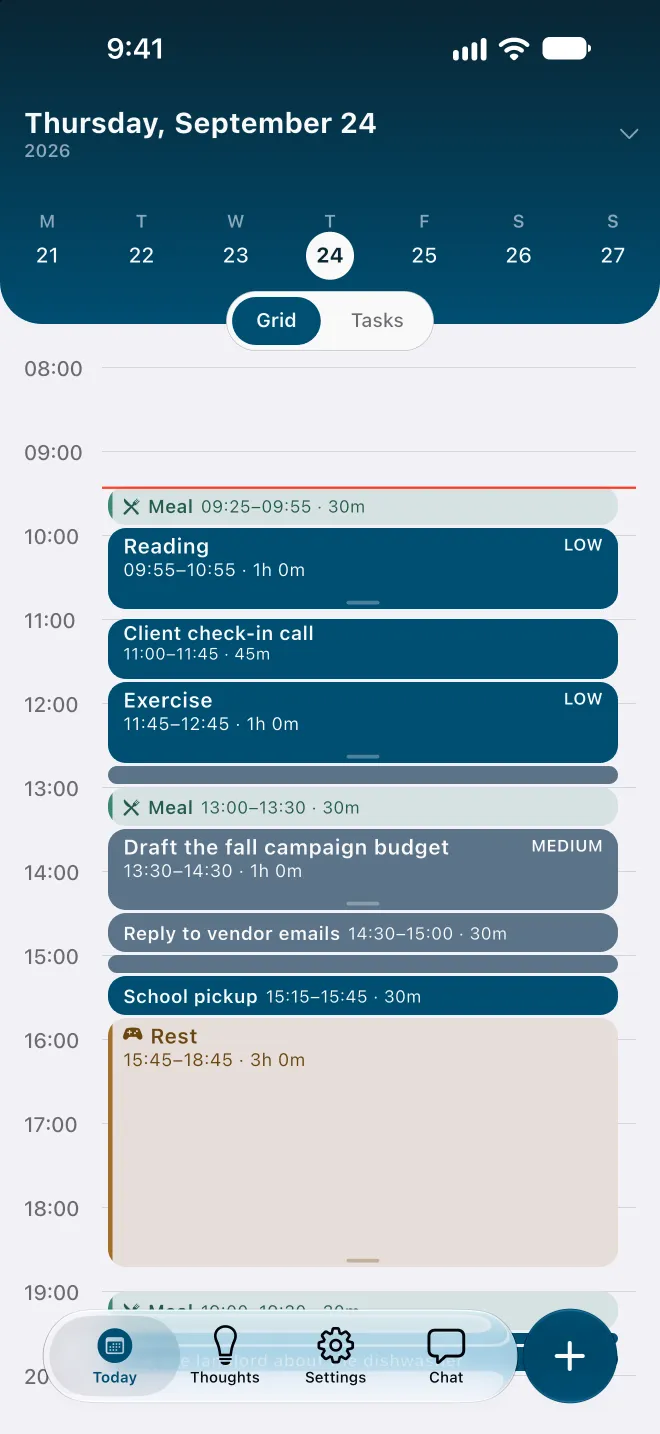
A planner makes the estimates visible. In Flowo, every task has a duration you set and can change, and the grid draws each block at that length, so a 90-minute budget looks like 90 minutes before the day starts. When a task runs over, you change its duration and the next planning run uses the new number. If the day can no longer hold everything, a task that cannot fit before its deadline shows a No room badge with roughly how much time is missing. The log itself can live in any notes app.
When this does not work
When no two instances are alike. A first grant application or a new design brief has no record to draw on, and the parts-plus-ratio method is a guess with a correction. Give a range, such as 3 to 5 hours, and write down how it ended.
When the delay belongs to other people. The log measures your working time. A delivery date also depends on other people's replies and approvals, and research on time prediction treats hours of work and completion dates as two different kinds of estimate (Halkjelsvik & Jørgensen, 2012).
When the evidence is stretched. The studies used students and tasks lasting minutes to weeks. The ratio rule has not been tested, and in one set of experiments simply knowing an earlier task's duration did not reduce bias (Thomas & König, 2018). If logging every task feels like a burden, log one task type for a week; even one row of honest numbers gives you something better than memory.
Questions
Why do I always underestimate how long things take?
Two explanations have support. People tend to picture how the task will go and set aside how similar tasks went before (Buehler et al., 1994), and the memories they do consult tend to be too short (Roy et al., 2005). A written record addresses both.
Should I just double every estimate?
A fixed multiplier overcorrects small tasks, which are often overestimated already (Roy & Christenfeld, 2008), and bias varies across tasks and settings (Halkjelsvik & Jørgensen, 2012). A ratio from your own log for each kind of task is a closer fit.
Does getting more experienced make my estimates better?
The findings point both ways. Repeating the same task made predictions close in the lab (Thomas & König, 2018), while experts underestimated more than novices in a study described by Roy et al. (2005). A record of actual times is the part that does not depend on how well you remember.
References
- Buehler, R., Griffin, D., & Ross, M. (1994). Exploring the "planning fallacy": Why people underestimate their task completion times. Journal of Personality and Social Psychology, 67(3), 366-381. https://doi.org/10.1037/0022-3514.67.3.366
- Forsyth, D. K., & Burt, C. D. B. (2008). Allocating time to future tasks: The effect of task segmentation on planning fallacy bias. Memory & Cognition, 36(4), 791-798. https://doi.org/10.3758/MC.36.4.791
- Halkjelsvik, T., & Jørgensen, M. (2012). From origami to software development: A review of studies on judgment-based predictions of performance time. Psychological Bulletin, 138(2), 238-271. https://doi.org/10.1037/a0025996
- Roy, M. M., & Christenfeld, N. J. S. (2008). Effect of task length on remembered and predicted duration. Psychonomic Bulletin & Review, 15(1), 202-207. https://doi.org/10.3758/PBR.15.1.202
- Roy, M. M., Christenfeld, N. J. S., & McKenzie, C. R. M. (2005). Underestimating the duration of future events: Memory incorrectly used or memory bias? Psychological Bulletin, 131(5), 738-756. https://doi.org/10.1037/0033-2909.131.5.738
- Thomas, K. E., Handley, S. J., & Newstead, S. E. (2007). The role of prior task experience in temporal misestimation. Quarterly Journal of Experimental Psychology, 60(2), 230-240. https://doi.org/10.1080/17470210600785091
- Thomas, K. E., & König, C. J. (2018). Knowledge of previous tasks: Task similarity influences bias in task duration predictions. Frontiers in Psychology, 9, Article 760. https://doi.org/10.3389/fpsyg.2018.00760
Conflict of interest: the author is a co-founder of Flowo, a planning app. None of the studies cited was funded by or connected to the company.
Related: breaking a task into steps, re-planning a day that has slipped, and how the scheduler works.
Flowo is free to download on the App Store for iPhone and on Google Play for Android, with optional in-app purchases.